


By Simranpreet Kaur, Staff Writer
In October of 2024, a 20 year old student, known publicly as Jane Doe, alleged that she was assaulted inside the Chi Phi fraternity house at Cornell university (Content Warning: this article discusses content that may be upsetting to some readers)
Jane Doe describes the assault beginning with her being pressured into consuming drugs and alcohol, before being sexually assaulted by seven male students for several hours.
For around two years, Cornell University and the New York legal system have kept quiet about the allegations. Many individuals have criticized Cornell for what is seen as not taking the proper legal action that should have taken place for this case, especially due to the severity of the crime and the circumstances in question.

After the assault had been brought to light, the fraternity chapter was shut down and internal panels met behind closed doors. They decided that the punishment for the alleged assaulters would be two expulsions, two suspensions, disciplinary probations, and hand written essays assigned to the rest. The local District Attorney also silently chose to decline pressing criminal charges, all of which has led to widespread critique and judgment of the decisions the administration took in an attempt to protect Jane Doe.
In September of 2026, Jane Doe, sick of what she viewed as the system’s failure and lack of action, filed a massive civil lawsuit against both Cornell University and each of the seven alleged assaulters.
What is now known as the “Cornell Seven” case has brought on national attention and has opened numerous conversations. The quick explosion of public outrage has highlighted the failures of the modern American university system, and the lack of accountability from the parties responsible for bringing justice.

For years, universities have held that Title IX offices are safe havens on campus for survivors of sexual violence, but the exposure of the Cornell Seven depicts an uglier story. It has revealed that, in many cases, the Title IX office has become an administrative system that operates solely for liability management, rather than bringing forth any form of justice.
The punishments chosen by Cornell have especially come under fire, as they allowed some of the defendants to stay enrolled on campus and be given essays to write as a consequence for the crimes they committed. These students were not being punished for shoplifting, hazing, or some other minor infraction, but for the extreme violation of another individual’s physical and emotional well being. The pure absurdity of this situation suggests a strategy built to maintain the school’s reputation: manage the details, revoke the blame, and sweep everything under the rug. It paints a picture of a university that values its own prestige and brand over life-time harm to their students.
The systemic failure appears so evident that New York Governor Kathy Hochul stripped the local prosecutor of authority and appointed the state’s own Attorney General as a special prosecutor to launch a new criminal jury investigation. Cornell was also forced to hire the former U.S Attorney General to conduct an isolated review of their sexual misconduct response policy. The very idea that an Ivy League school would need to do so points to the fact that it is the school’s own internal systems that failed to protect Jane Doe.

The Cornell Seven’s legal defense relies strongly on the “voluntary intoxication” loophole within New York state law. This law essentially states that if a victim willingly consumes alcohol or recreational drugs before an assault, it is remarkably difficult to prove the encounter violated the boundaries of consent.
Local prosecutors and defense attorneys have been weaponizing this grey area for years, shifting the legal focus away from the behavior of the perpetrators, and instead onto the sobriety of the victim. In the Cornell Seven case, newly surfaced text messages illustrate a darker picture. Jane Doe, in her highly intoxicated state, tried to rationalize the trauma she was faced with. These text messages are being used to contradict her official police statements, that she has “100% confidence” that she was sexually assaulted
Within the voluntary intoxication loophole, the justice system seemingly offers sexual predators a deliberate, clear out to target any individual who is intoxicated to any degree. Public fury toward the Cornell Seven and calls for change have begun to force state lawmakers to take this example of victim blaming and prevent it from happening again.
Through new discoveries and work done by the Cornell student paper, The Cornell Daily Sun, the entire case—details of the attack, the failure of the university’s internal investigation, the invitations on social media for others to join the assault—was spread open to the public for all to see. This visibility, bolstered by celebrity attention and student protests, has allowed for pushes for accountability and forced the hand of the state government.
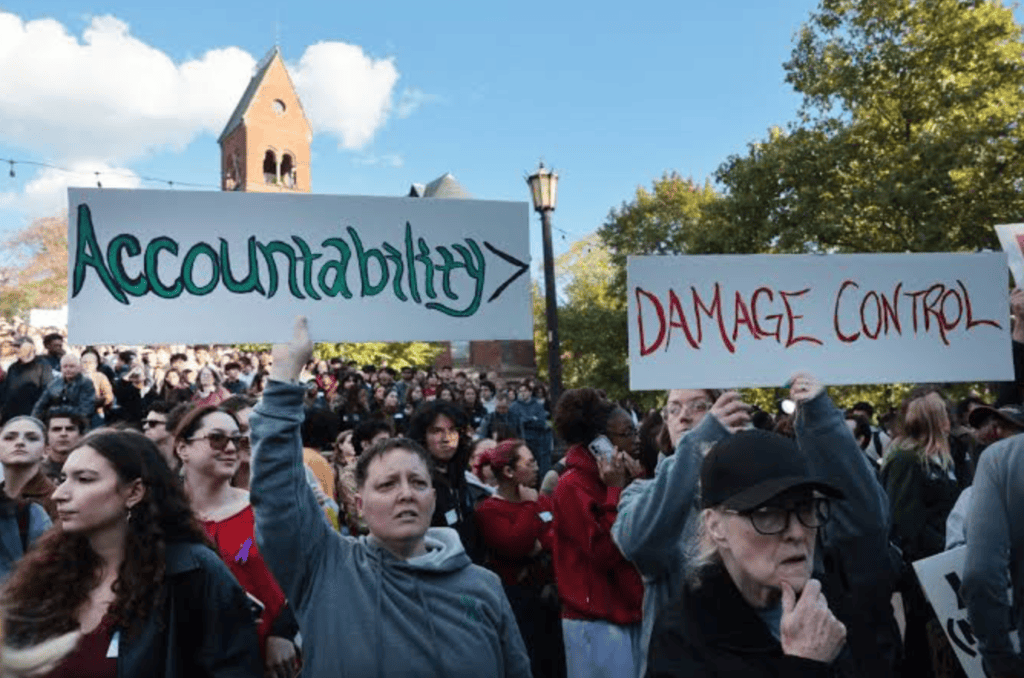
Cornell students are currently staging multiple hour long sit-ins, and faculty members of the school have pushed for votes of zero confidence against university leadership. The conversation has clearly stepped beyond just the actions of seven individuals. The Cornell Seven case forces people to confront a truly unsettling question of whether or not these elite universities and Greek Life houses can actually be held accountable to act responsibly, and what consequences they will face if they don’t.
When justice for sexual abuse survivors is only given after state government intervention, special investigations, civil lawsuits, and national media attention, it becomes clear how the system is fundamentally broken. Systematic change will not arise from small administrative changes or private university directed reviews, but from stripping the authority over these cases from universities. Universities should not be able to dictate the investigations or consequences of violations of the law, even those done by students. The government should always be involved in cases of this severity, even if they occur on campus, as they are still alleged crimes that deserve a proper legal process to bring about justice.