

By Anabelle McKay, Staff Writer
The midterm elections saw extraordinary Democratic victories in a majority of crucial races, a critical loss for the Republican Party in light of President Trump’s first two years in office.
Dissatisfaction with the Trump Administration’s economic, domestic, and foreign policies have heavily impacted the President’s recent approval ratings. Voters cited increased cost of living, ICE-related violence, and the war in Iran as significant issues that affected their choices at the ballot box.

As a result, the Democratic Party won control of both the House and the Senate, as well as gaining a majority of the nation’s gubernatorial positions. Votes swung left in a number of traditionally right-leaning states, a sharp contrast with the Republican wins only two years prior.
The most-watched race on a national level was for a Texas seat in the Senate between Democratic candidate James Talarico and Republican incumbent Ken Paxton. Talarico won the vote by 12 points—1.2 million votes—leaving Paxton the first Texas Republican to lose a Senate seat since the 1990s. Along with Talarico, Democrat Gina Hinojosa defeated GOP opponent Greg Abbot in Texas’s gubernatorial race, becoming the state’s first Latina governor.
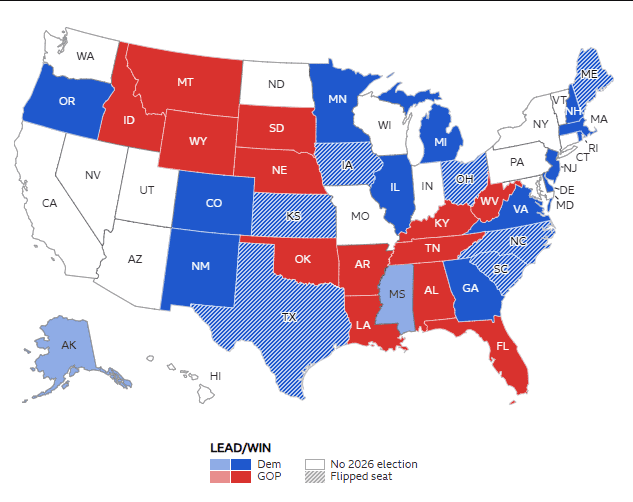
The left also claimed a historic victory in Kansas, where Adam Hamilton beat Republican Roger Marshall by 5 points, a first for Kansas Democrats in nearly a century. In New Hampshire, Chris Pappas prevailed over his GOP opponent, gaining yet another Senate seat for the Democratic party and becoming the country’s first openly gay senator.
Key battles in South Carolina, Michigan, and Maine culminated in Democratic victory with candidates Annie Andrews, Abdul El-Sayed, and Troy Jackson, respectively. Similar Senate upsets occurred in Georgia, Iowa, Minnesota, North Carolina, New Hampshire, and Ohio, all of which experienced Democratic wins in historically red states.
In gubernatorial races, Democratic candidate Keisha Lance Bottoms claimed a crucial victory in Georgia, making her the first black woman in history to serve as a U.S. governor, and Deb Haaland became America’s first Native American governor when she triumphed over her Republican counterpart in New Mexico.
Spurring the Democratic triumphs were significant shifts in the votes of various demographics. In the 2024 presidential election, key groups consisted of young voters and Hispanic voters, both of which had a relatively even split between GOP candidate Donald Trump and Democrat Kamala Harris.
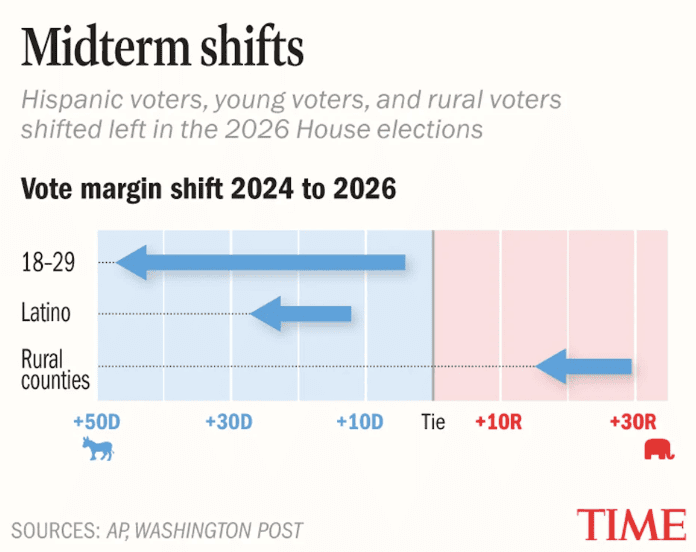
In last week’s elections, however, both groups swung left, gaining the Democratic Party a notable majority in only two years. According to AP polls, 70% of young voters and 66% of Hispanic voters opted for the Democratic candidate in House races.
Many young voters expressed that their left-leaning votes were intended to be a message to President Trump, making clear their opposition to his current policy. Hispanic voters held more specific reasoning, backing up their ballots with worries of an ever-worsening economy.
Also aiding in Democratic victory were candidates who took a more centrist stance on issues that previously had a sharp partisan divide. Abortion, religion, and immigration had Democratic candidates finding a middle ground when faced with questions regarding the topics on the campaign trail.
In the elections as a whole, the Democratic Party earned a landslide victory, gaining at least 7 seats in the Senate, 30 in the House of Representatives, and 5 Governor positions, with possible pending victories in various states.
Voters are sending a clear signal to the American Government: They are unhappy with recent federal policy, and they can—and will—change their minds, despite any history of party loyalty. Thus, the Democratic Party now holds significant control over congress, giving it the opportunity to check Republican and presidential power.