

By Ella Fortine, Staff Writer
Students express their anger over the recent Trans athlete situation with a protest after school.
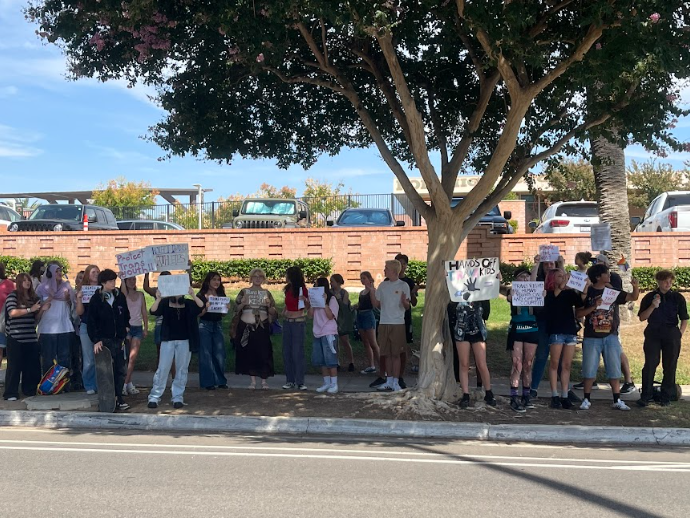
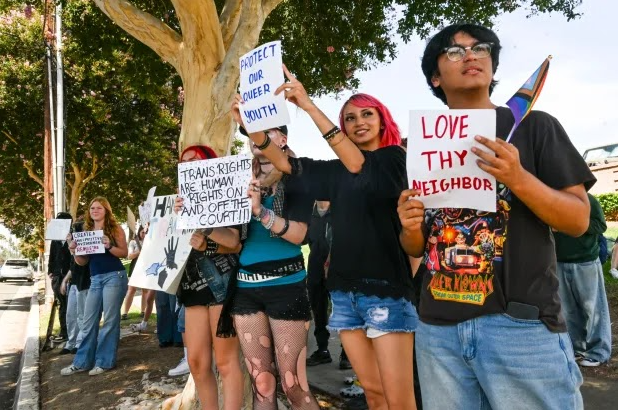
On Wednesday, August 20th, over two dozen Poly students gathered in front of the school to make their voices heard. The protesters marched down Victoria Avenue over the course of two hours chanting and waving handmade signs in support of the transgender athletes of Riverside Unified School District, a highly contested subject in recent months. This protest came in response to the forfeiting of a girls volleyball game between Poly and Jurupa Valley that was widely thought to be due to the presence of a trans athlete on the Jurupa Valley team (yet never confirmed by Poly’s administration,) and the subsequent official RUSD Instagram post that opened the floor for adults from across Riverside to harass and cyberbully a minor. Although RUSD had no other choice than to leave the post open for comments, as that is the law, the resulting hatred spewed ultimately was harrassment and cyberbullying of a minor.
Trans athletes, and especially trans women in women’s sports, has proved to be a topic of heated debate, especially in the wake of the 2024 presidential campaigns. Then presidential candidate Donald Trump focused a large portion of his campaign calling into question the rights of transgender individuals in both sports and beyond. Earlier this year, the House of Representatives proposed the “Protection of Women and Girls in Sports Act of 2025”, which states that “sex shall be recognized based solely on a person’s reproductive biology and genetics at birth” and moves to pull federal funding from organizations, including public schools, that permit transgender girls and women to participate in single sex athletic programs or activities. The bill has not passed the Senate or been signed by the President, but the threat of federal action along with social pressure could possibly push public school districts to preemptively remove athletic opportunities for trans students. More recently, a lawsuit involving two students from King who, in response to the admission of a trans athlete, wore shirts targeting the student. When asked to remove the shirts as they violated the school bullying policy, the students sued over the issue claiming it was a restriction of their free speech. This incident started the “Save Girls Sports” movement which focuses on the barring of trans girls from school sports. Members of this movement have been present at school board meetings and active in attempting to prohibit the very small population of trans athletes in RUSD from participating in sports.
The protest on the twentieth was a challenge to all of these movements. Students carried signs advocating for the respect and protection of trans athletes, with steady chants of “trans kids are kids” and “protect our students”. Protester and junior Mary Garcia noted that “public schools have often made anybody in the LGBTQ+ community, especially trans people, feel uncomfortable or unsafe.” This demonstration was a demand for RUSD and Poly to promote a more accepting environment for their trans students. While a great many of the protesters were students at Poly, some, like Mary Grace Hedge, were family members who cared about the treatment of trans athletes. Hedge, the grandmother of a Poly student on the volleyball team, affirmed the effectiveness of protesting in getting attention. “Even if we are the minority, if we do not speak out who’s going to?” she remarked, recounting how her brother suffered a mental breakdown in the sixties as a result of staying closeted. Her reasons for protesting were “to support the Poly volleyball team that did want to play as well as [the] transgender girl’s right to play.” The ability to get attention was proven by the presence of both the Press Enterprise and ABC 7, who interviewed several of the protesters.
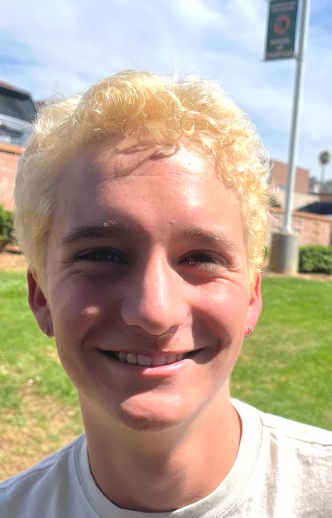
While any community action, like protesting, takes the effort of several individuals, the student most involved was sophomore Nate Firetag. Firetag, along with junior Zander Hix, rallied together frustrated students regarding RUSD’s post. They planned the protest, and reached out to the Press Enterprise to cover the protest. He felt that a protest would be the quickest way to bring the most attention to the issue and “show the public that students at Poly care about other people.” His message to trans students is “you matter, you have rights, you deserve respect as much as anyone else,” embodying the fighting spirit of everyone present at the protest. In response to the demonstration, Mr. Hansen has coordinated with Firetag and other students to meet with administrators and discuss the group’s concerns. While nothing has happened yet, it certainly illustrates the attention that such a movement can grab. When it comes down to it student action can be extremely powerful, and many Poly students are determined to wield that power to support their trans peers.