

Written by: Isabelle Termath, staff writer
Taylor Swift releases her twelfth studio album on October Third; why are people so against it?
In early August of this year, Taylor Swift, who is arguably the most popular artist these past few years, announced her twelfth studio album, “The Life of a Showgirl,” on her now-fiancé’s podcast. The episode featured her discussing a variety of topics, such as the Eras Tour, buying back her masters, and the upcoming album.
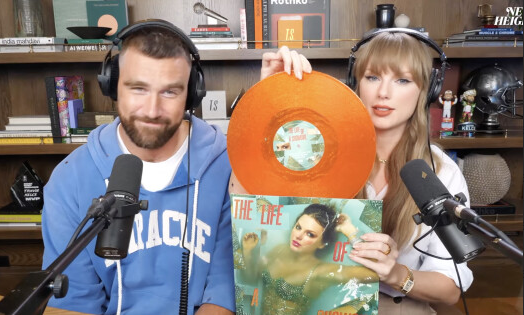
Many were likely not expecting this announcement, considering that Swift just completed the most successful tour in history last December, and was in a state of hyper-productivity for several years, having released eight full length albums in the span of four years (including four re-recordings of her previous albums).
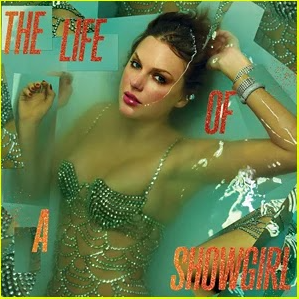
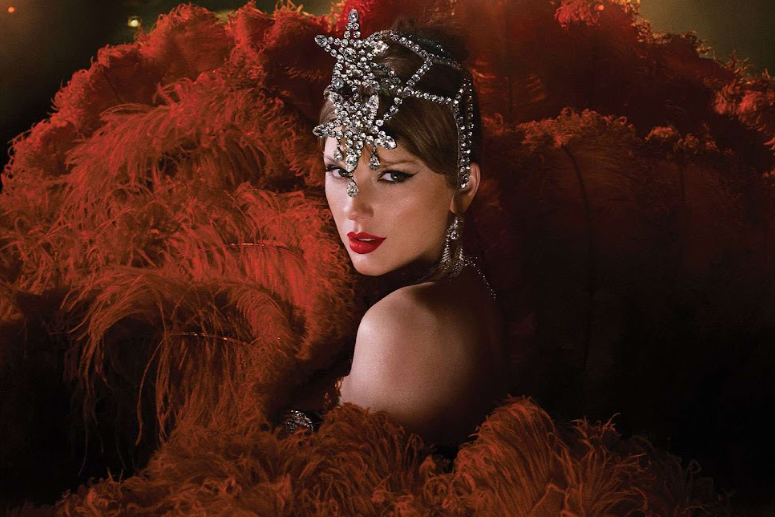
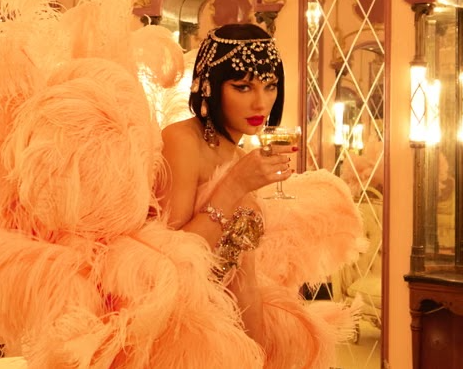
Nonetheless, fans were excited. Swift stated she made this album while still performing on the European leg of her tour. The cover featured Swift lying in a bathtub, in makeup and a sparkly outfit. She said fans saw what was happening on stage, and this album would reveal what was happening “behind the curtain.” The world that was seeming to be built for this new era was full of feather headdresses, elaborate costumes, glitter strewn on the floor, the smell of sweat and champagne, and a showgirl at the center of it all.
Swift’s fiancé, Travis Kelce, proudly described the album as “twelve bangers.” Swift affirmed this by alluding to, but not explicitly comparing the new project to, the massive hit-producing 2014 album, ”1989,” while still retaining the lyrical prowess seen on “folklore,” released in 2020. This expectation of the album that most fans had can be attributed to the fact that Swift was now returning to work with well-known producers Max Martin and Shellback, who she said were adamant in their support for the story-telling she had developed in her writing since they last worked together on “1989.” Swift emphasized how the album had only twelve tracks, which she claimed was an effort to remain cohesive and have a higher quality of music. Swift acknowledged that she was placing an immense amount of pressure on this new work, but she firmly stated that she did not care for she loved it so much, since it was her “favorite thing” she has made.
Thus, as October third approached, anticipation for the album began to grow. Fans anxiously awaited the twelve new tracks, and were ready for this departure into a new era. The album opens with “The Fate of Ophelia,” the album’s leading single. It consists of a soft piano that leads into a catchy melody that will be hard to get out of your head. “Ophelia” is essentially a rewrite of the ending to Hamlet by Shakespeare. Swift is saying were it not for the person she loves, her heart would have met the same fate as Ophelia, who was driven mad by men until her death. While it may be a bit wordy at times for the casual listener to grasp on to, the track is a strong opener for the album, and it is clear why it was chosen as a single. The second track is titled “Elizabeth Taylor.” It has perhaps the most theatrical production amongst the twelve tracks. The verses are mellow and contained, while the chorus is loud and full of emotion. Swift makes comparisons between her life and Taylor’s, adding specific details of the latter’s, such as Portofino and the Plaza Athénée. Brimming with melodrama, Swift repeats the question, “Do you think it’s forever?” throughout. Overall, it is a solid and straightforward piece to lead into the album with.
Continuing to track three, we have “Opalite.” The song is best described as an infectious and romantic one. It discusses past failures in love, but now that is all over, and happiness is found. This song was made for radio, with its catchy chorus and production. It is an easy-listen, and is definitely one of the highlights of the album.
The fourth track is titled “Father Figure.” Swift’s take on the subject is through the perspective of a powerful person, taking an up-and-coming artist under their wing. As the song progresses, the listener sees how the young artist is taken advantage of, until the end when the perspective switches to the younger artist eventually surpassing their mentor in success, power, and money. It is an interesting subject matter. However, it is one of the less relatable songs for the masses. But it is inoffensive to listen to, and concludes a solid first-four tracks.
Track five is titled, “Eldest Daughter.” This is perhaps the weakest point in the album. Swift uses slang such as “trolling and memes,” “savage,” and “looked fire,” among a few other phrases, which can take the listener out of the experience and detract from the actual music. The subject matter itself is also hard to pin down. The song opens with a lamentation of the apathetic behavior seen on the internet, then to the chorus in which Swift says she is not cool while also promises the person she is speaking to that she’ll never leave them, then mentioning the condition of the eldest daughter for a mere two lines. There does not seem to be a fully formed idea, much less two that adequately connect. The production is also generic and forgettable, and will make the listener feel as if they’ve heard something like it before, something better. The track overall does not deliver emotionally-appealing lyrics, which is what seemed to be the goal, and this is not made up for in the production.
The sixth song, “Ruin The Friendship,” is an odd one. It does not tell the story of what happened in relation to behind the scenes on the Eras Tour. In fact, it recounts a story from high
school. Swift looks back and wonders what would have happened if she had taken a few chances in love. It is initially a very bright and bubbly track, but is brought to a screeching halt when it is revealed the person Swift is talking about has passed away. It leaves the listener unsure of how to react once the song is over. Overall, it is not a bad song by any means, but compared with other selections, it is not so revolutionary.
Track seven is titled “Actually Romantic,” and is one of the more interesting songs in the album. It is Swift’s take on hatred one might have for someone, and how it is actually really flattering instead. The production is engaging to listen to and is generally one of the more favorable tracks.
Going into track eight, titled “WI$H LI$T,” may leave the listener disappointed. This also is one of the less appealing songs. The lyrics are nothing to write home about, and the production is not very interesting. There is simply not enough substance to it, and holds back the album. Track nine is titled “Wood.” The production is fun, but the lyrics however are not quite what one expects when listening to a Taylor Swift song. There are many allusions that are not good writing in the first place, and also take the audience out of the listening experience. This song is definitely one of Swift’s lyrical lows not just in the album, but in her discography.
Leading into “CANCELLED!”, we have Swift proclaiming she stands by those who the public deems to be, well, cancelled. This subject of being cancelled is one she has written about extensively before, and has done in a better manner. Track ten comes across as slightly tone deaf, and contains more slang, such as “girlboss,” which makes it hard to take her seriously when she is trying so hard to be that.
The second-to-last track is “Honey,” which compares how nicknames can be passive aggressive from some, but loving from others. It is inoffensive, but forgettable. It is sweet, but does not contain depth. There is not much to say about it, other than it is a filler track.
The final song is “The Life of a Showgirl,” featuring Sabrina Carpenter. It is a take on fame we have seen before; so many long for it but those who have it give warning. The production is better compared to some of the preceding tracks, but still is unexciting. Perhaps the most stimulating part of this track was Carpenter’s feature, and the end of the song, which is reminiscent of the closing goodbye on the Eras Tour.
“Showgirl” also delivers fun tracks such as “The Fate of Ophelia” and “Opalite.” It is a departure from the themes covered exhaustively from her most recent albums, and a return to collaborations with Max Martin and Shellback, who she has not worked with in years. However, this album is not her best. The lyricism, compared to what she has proven herself capable of, is disappointing. The production is underwhelming and even boring at certain points. The purpose of this album is unclear, and if Swift had waited at least one more year to recover from the exhaustion of her tour, the overall quality could have been enhanced. The significance of this album is not great, especially within Swift’s discography, and reminds listeners that even the most acclaimed and talented artists can release art that does not land with critics, the general public, and die-hard fans.