

Written by Acacia Bernier, Staff Writer
Read further for an overview of the Olympic journey of U.S. figure skaters Ilia Malinin and Alysa Liu and how both their wins and losses come as a lesson to us all.

The Winter Olympics, hosted in Milan Cortina, Italy, were full of excitement, achievement, and the most astounding winter sport athletes in the world. It was truly a sight to behold, with approximately 2,900 athletes representing over 90 nations around the world competing in 16 disciplines across 8 sports.
While there is so much to enjoy at the Olympics, it was a certain sport that maintained much of the spotlight this Winter Games, as it is accustomed to. Figure skating, the art on ice, became the focal point for American watchers when we were introduced to men’s figure skater Ilia Malinin and women’s figure skater Alysa Liu, both of whom grasped the attention of athletes and spectators alike in the best way possible. Just two American figure skaters showcased a dazzling degree of talent and performance that pulled viewers to the TV. While their alluring status as skaters was a similarity between these two, their fates could not have been any more different.

free-skate performance.
Ilia Malinin, the 21-year-old American figure skater, has been nicknamed the “Quad God” after he completed the first quadruple Axel in competition in all of history, as well as completing a single program consisting of all 6 types of quad jumps. He is a trailblazer to say the least, and after winning gold at the Grand Prix Final this last December, he was set up to be the most difficult competition for other athletes, and he certainly exuded the confidence to back it up.
Thus, when the U.S. won gold in the Figure Skating Team Event, it was no surprise that it was Ilia and his supernatural performance that carried the team’s score. The media was boiling over with Ilia—he was an Olympic celebrity and athletic superstar, but could that ever hinder his performance? Inevitably, there is a point where athletes crumble under the pressure and expectations, and it was in Ilia’s last free skate to secure his medal that it all fell apart. It revealed the vulnerabilities of putting someone on a pedestal, and it’s evident that the media and attention pinned on Ilia were detrimental to his success at the Olympics. Truly a real-life Icarus, teaching us all that too much confidence and pride do not build one up, but break one down.
However, what happens when one takes away this factor of pride and expectation? You then have Alysa Liu.
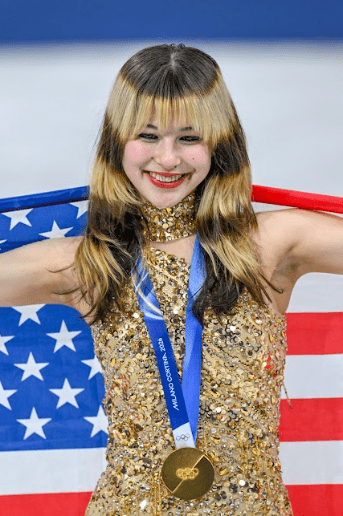
A bright and shining personality without the glitz and glam of reputation, she came into these Olympics in hopes of further igniting her love for the sport. Alysa, a 20-year-old U.S. figure skater, retired from the sport at 16 due to the immense pressure placed on her at such a young age. Her return, then, was because of her passion for the sport, not expectation, and artistry, not athleticism. It was Alysa Liu’s energy at the Winter Games that stood out—free, young-spirited, and never without a smile. She stated in an interview that “winning isn’t all that, and neither is losing,” and when it came to pressure, she simply “didn’t feel it” because all she desired was to express herself and showcase her artistry. Thus, when it came down to her final free skate, unlike many of the other skaters, she floated on the ice, carefree and captivating. Not only that, but she was flawless, and that inevitably secured her the gold medal for the United States in women’s figure skating.

Thus, while these two skaters, Ilia and Alysa, are two entirely different skaters, genders, and athletes, their stories in these Winter Games became didactic in a sense, illustrating the ups and downs of an athlete’s career, and that nothing is ever guaranteed nor too far out of reach. While Ilia’s loss was a true tragedy, and Alysa’s win a triumph, it comes as a lesson that one must first take care of their mentality before anything else, because if one has too much pride, it may become fatal to their success. Likewise, if one centers their goals around passion and love, it is no longer about loss or win, but about expression, and as long as it is true, then one can never lose.