


By: Noemi Martinez, Staff Writer
Test your morality and test your thinking. That’s the purpose of the SoCal Regional Ethics Bowl, hosted yearly by Chapman University. Since 2015, high schools have gathered to test their ethical and philosophical debate skills in respectful, competitive matches.

The debate part is a little tricky.The purpose is not to win an argument, but for students to have the best argument possible. The opposing team can, and often does have a similar viewpoint. Debaters are provided with tricky ethical scenarios, often sourced from real events, and prompted to create nuanced arguments on an ethical question. Think debate, but philosophically and ethically fueled. After presenting their main argument, the opposing team presents a rebuttal to either challenge or force expansion in the presented reasoning. Post-response to the rebuttal, is the most difficult and concluding aspect of ethics bowl: judge questions.
Judges ask questions to challenge thinking and present ethical dilemmas that stretch the parameters of thinking. It is – in the opinion of a past participator – one the most intimidating and exciting portions of the ethics bowl. Questions are asked with no time to prepare, only the quick thinking of team members. It is a great way to push argumentative skills and learn how to think complexly under pressure.

For Poly’s team specifically, members meet every Tuesday and Thursday during Lunch A with Mrs. Wilson, one of the wonderful sophomore English teachers and the philosophy/ethics teacher. When the case set, the unique set of ethical scenarios, is released, members prepare by organizing their thoughts. In thorough discussions and mock debates, they create a solid ethical basis to have prepared as reference for the actual ethics bowl competition.
On the day of the competition, members are encouraged to dress in business adjacent attire. Looking smart is not only a great way to present oneself, but a sure way to impress judges and assure them of your professionalism. After a provided breakfast, teams are sent off into different rooms to represent the ethical thinking of their schools. Inside of the rooms, there’s a table for the three judges, and two opposing tables for the different teams. Seating is provided for any welcome spectators. There are three rounds, with each round consisting of two matches, totaling to roughly 50 minutes each. At the end, the moderator will announce the score difference and thus, the winner.
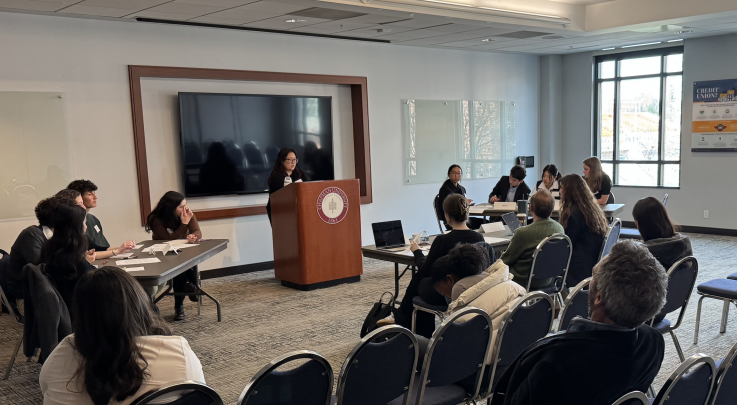
It’s important to note that teams switch between two positions, being the main debaters and creating their argument, and creating a rebuttal. Members who participate in the ethics bowl will experience both parts of the ethical debate, to create and respond to ethical arguments. When it comes to winning, there are many scoring factors. Generally, it can be broken down into three main categories: initial argument, rebuttal creation and response, and judge questioning. Judges score throughout the matches, and finalize their positions after questioning occurs. Teams are also able to earn additional points – and awards – for sportsmanship, courtesy, respectfulness, and many other categories based on creativity and civility. A little after the ethics bowl, judge comments are released so participants can reflect and improve on any desired areas.
After the three rounds, teams and advisors are welcome to stay for a provided lunch. Regardless of victory or loss, the experience of the ethics bowl is unlike any other. Even without the element of competition, it is a wonderful way to not only share thoughts on ethical behavior, but have an open conversation with other thinkers. If you are interested, visit Mrs. Wilson and find out more about the spirit of ethics bowl!