

Written By Ella Fortine, Staff Writer
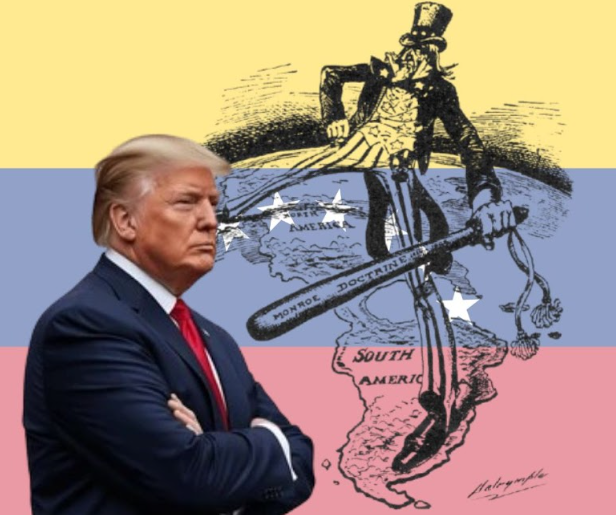
The capture of Nicolás Maduro could be a revival of America’s previous explicit Washington-directed control over Latin America. Is that the America Trump wants to make great again?
It has been almost one month since the capture of Nicolás Maduro on January 3rd, 2026. Various discussions have sprung up throughout the month, which is, of course, to be expected. Military action of this level is quarrelsome for several reasons, however none of those reasons are ones we have not seen before. In fact, Trump’s actions in Venezuela reflect how U.S. foreign policy has functioned for almost as long as the nation has had foreign policy. The argument can be made about the righteous “American-ness” of Trump’s decision, but historically speaking Trump is proven to be acting according to the American way (if a bit louder and brasher than previous iterations).
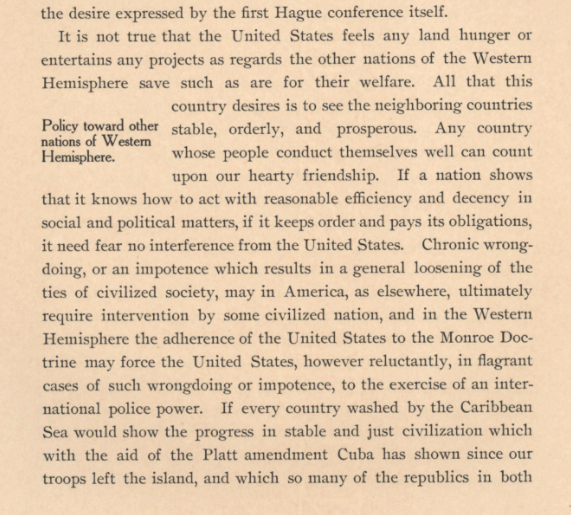
As Latin American nations began to gain their independence through revolutions that threw off the bonds of their European colonizers in the early nineteenth century, U.S. foreign policy found itself with something to be concerned with other than the strict isolationism it had followed previously. This concern culminated in the Monroe Doctrine, a statement that intended to protect the newborn nations of Latin America from recolonization. This was later expanded upon by the Roosevelt Corollary of 1904, which was an addition that declared the United States’ power to intervene in the affairs of Latin American nations as it saw fit to remedy “[c]hronic wrong-doing, or an impotence which results in general loosening of the ties of civilized society,” (Theodore Roosevelt’s Annual Message to Congress for 1904). These foundational policies towards our neighbors to the south set the stage for the further encroachment upon the sovereignty of nations that loosened the ties of civilized society, or in some cases, became inconveniently socialist and terrible for the economy.
With European interest out of the picture, as guaranteed by the Monroe Doctrine and Roosevelt Corollary, American corporations had the opportunity to pillage, or rather, do business with the nations deemed under the sphere of influence of the United States. Poly U.S. History teacher Eric Bautista describes the system by which this ‘business’ occurred, describing how “[the corporations] set up a system of corruption within these countries that allowed them to prosper economically [which] also brought about great suffering for the working class”. This corruption differentiated many of these nations as ‘banana republics’, a term coined in honor of the notorious United Fruit Company most well known for its tropical fruit and modern slavery allegations. As the USSR gained geopolitical power after World War II and the subsequent beginning of the Cold War, many Latin American countries had their eyes opened to a system of governance that was not dependent on the will of the American market. To keep the market ever content, the U.S. government was more than willing to use covert action and CIA operations to ensure the utmost cooperation of various Latin American nations. “The support of dictators was continuous, and these countries were oppressed under these regimes that the U.S. supported”, States Bautista, along with the excessive violence that terrorized people into submission. The toppling of governments and installation of U.S.-friendly dictators is a practice that federal agencies are all too familiar with. The only catch is that now it is being done in broad daylight.
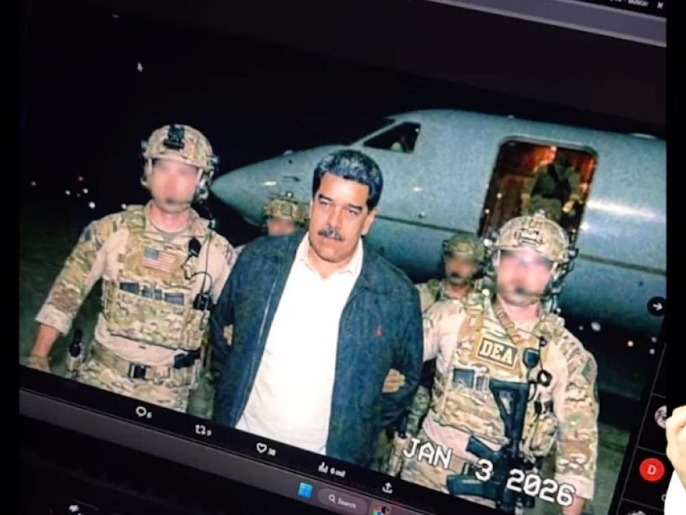
This has been a 500 word history lesson, which is by no means an adequate account of the complexity and depth of the interactions between the U.S. and Latin American countries. To have a full, complete understanding would take lots of research and time. But that time would be well spent as it is worth understanding the context of our nation’s actions today. Nicolás Maduro was captured on January 3rd. This is not the first time the U.S. has decided who the leader of a Latin American country will or will not be. It is not the first time the U.S. has violated foreign sovereignty for oil, or fruit, or fear of some vague communist threat. It is important for the American populace to understand that, or else what happened in Venezuela will be only the first step on the path Trump seems intent on heading down—one to an America that not only reshapes foreign governments by night, but in broad daylight.