

Written by Isabelle Termath and Emma Goad, Staff Writers
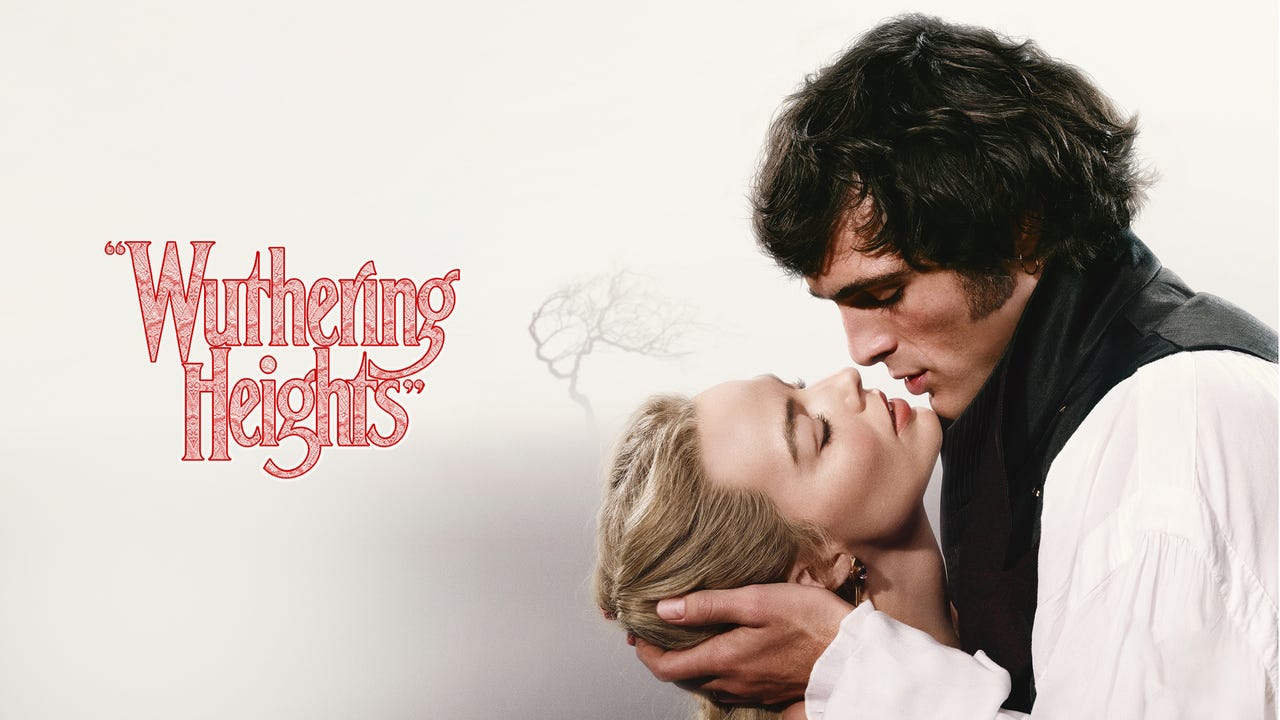
Emily Brontë’s novel has been adapted into Emerald Fennell’s “Wuthering Heights” (2026), but does the movie live up to the eloquence of the original material?
This past Valentine’s Day, a new adaptation of the novel Wuthering Heights, by Emily Brontë, hit theaters. It was directed by Emerald Fennell, who is known for her works such as Saltburn, and accompanied by a soundtrack created by Charli XCX (who is credited as a producer), whose album is of the same name.
The greatest strength of this movie is its visuals. There are many beautiful shots with intriguing coloring, such as when Catherine Earnshaw returns to her childhood home. Her red velvet cloak is an elegant contrast to the drab and gray environment. Additionally the setting of the novel, the moors of England, is captured by the heavy fog, the rich greens of the land, and the incessant rain. The moors are just as much a character in the film as they are in the novel; there is an eeriness and humidity that permeates the screen. However, this emphasis on camera-work sometimes hurts the film. In certain scenes, the shot goes from such an up-close visual where the viewer can hardly see what is taking place to a shot fifty feet away, where the viewer still cannot decipher what is happening. It leaves one with whiplash and utter bewilderment at why the director is determined to use both in succession during such important scenes like Heathcliff’s and Cathrine’s first kiss. Unfortunately, striking visuals and gorgeous coloration are this movie’s only saving graces as every other aspect of the film reaches such lows that are hard to believe for an adaptation of a classic novel.
To understand how this movie falls flat as an adaptation, one must first understand the story it is adapting. Set in the bleak Yorkshire moors, Wuthering Heights is a Gothic novel that tells a tale of revenge, love, and obsession that brews over the course of generations. We learn of the events that take place through the journals of a traveler named Lockwood, who transcribes them from the recollections of the housekeeper, Nelly Dean. Heathcliff, an orphan at Wuthering Heights, grows up in an abusive household at the hands of his foster brother, Hindely, who is jealous of the affection his father and sister, Catherine Earnshaw, give him. When Catherine decides to marry Edgar Linton, Heathcliff runs away. When he eventually returns, we learn of his newfound wealth and desire for vengeance. To get revenge on Catherine, Heathcliff elopes with Isabella, Edgar’s sister, and they have a son named Linton. Eventually, Catherine gives birth to a daughter, who is named after her, and dies shortly after. Hindley also has a son, named Hareton, who Heathcliff abuses after Hindley’s death as a way of revenge for all the abuse he faced as a child. Through manipulation, Heathcliff takes control of both families’ estates and belittles the following generation. His cruelty only comes to an end after his death. Only then can the next generation break free of his vengeful and bitter nature, and cultivate their love for one another. So, how does this adaptation completely get the story wrong?
The movie’s failures ultimately stem from the casting. While they are two distinguished actors with prominent success in recent years, Margot Robbie and Jacob Elordi were not at all similar to the novel’s characters. Robbie’s character is a young girl, named Catherine, in her teens, with dark hair and eyes. In contrast, Robbie is a blonde-haired and blue-eyed woman in her thirties. While her features are not so consequential for the story, her age is. Catherine is a petulant teenager who acts on rebellious instincts; her attitude is logical, maybe even charming at select times, when considering her age. However, when the viewer sees a thirty-five-year-old woman acting juvenile and immature, this understanding is removed and thus creates further dislike for the heroine. The author’s intention is to leave an impression of distaste for Catherine, but this has been diluted to indifference from the audience for Fennell’s rendition of the character.
The most glaring failure of the film, perhaps, is the casting choice of Jacob Elordi. Elordi’s character, Heathcliff, is a man of color. His race is never explicitly referred to in the novel since he is an orphan child whose origins are unknown, but he is alluded to being of Romani descent. This is a vital aspect of the story as the racial prejudice, his lower social standing, and his lack of education is what shapes him to become the vengeful man he is later on. It is the root of not only his suffering, but that of almost every character in the novel. The blatant ignorance and disregard for the story in casting a white man sets this adaptation up for failure before the cameras even start rolling. The removal of such important context leaves Heathcliff’s character to be a mere brute who lacks complexity. In the book, the audience is not supposed to sympathize with Heathcliff nor his villainous actions but they are supposed to understand why he is committing them. This understanding is turned into annoyance and apathy towards Elordi’s representation in the movie; he is instead this senseless man with bad sideburns who is angry that he did not get the woman he wanted.
home on Christmas.
Another glaring disappointment of the adaptation is how it diminishes the obsessive romance between the two leading characters into a provocative love affair. For clarification, Heathcliff and Catherine never come so close as to kissing in the novel but rather pine and yearn for each other from afar. Fennell, however, thought it right to include almost a ten minute montage of all the times the two were intimate, which resulted in valuable time being wasted on moments that never happened. Instead that screen time could have been used to portray the story events in a somewhat accurate manner, something Fennell does not even come close to doing in a two-hour film.
Another significant offense of this film is its neglectful attitude toward its source material. Many minor details are altered, which can be forgiven in an adaptation; however, various plot points are changed which shifts the movie towards fan fiction rather than an adaptation. In fact, the whole second half of the book is erased! The second half of the book revolves around the third generation: the children of Catherine, Heathcliff, and Hindley. However in the film, Catherine miscarries her child, Heathcliff never has one with Isabella, and Fennell completely removes Hindley from the story. So, what story is Fennell trying to tell here? All that remains to be told is a toxic love infused with her own fantasies. The audience is robbed of the layered story and is left with a careless adaptation of only a small aspect of the novel.
Alongside this, the abrupt ending that occurs after Catherine’s death, in juxtaposition to the book in which she dies less than half way through it, erases much of the complexity of the novel and leaves out various important scenes. For example, after Catherine’s death she is buried with a locket in which held Edgar’s hair. However, Heathcliff, in an act of grave robbing, goes and switches out Edgar’s hair for his own. After that, Nelly goes back and braids Heathcliff’s and Edgar’s hair together in the locket, symbolizing how there was no correct answer for Catherine in regards to whom she would have picked. It also serves as a redemption arc for Nelly. In the film, her character seems to be branded with Heathcliff’s original personality. She is blamed for the downfall of two leads. Fennell completely overlooks the fact that it is Catherine’s and Heathcliff’s own selfishness that leads to their partition. The erasure of those moments, like Nelly altering the locket’s contents, in the film takes away from the most interesting themes explored in the novel.
Fennell states in an interview that in this movie she wanted to deeply explore the blurred lines between love, obsession, and violence. I think this is conveyed very prominently – so prominently, in fact, that it feels incredibly dumbed down and that she is more telling the viewer rather than showing. For instance, Heathcliff tells Isabella Linton (although it is clear this is a means to tell the audience) that he is “monstrous,” someone who she should be afraid of. He does this while he is seducing her, yet another one of Fennell’s haphazard attempts at depicting the tension between love and violence. But as I listened to his monologue, I pondered what exactly has he done so far that is truly “monstrous.” Sleep with a married woman? Immoral, sure, but not monstrous. And that is when I realized all that is monstrous about Heathcliff is revealed in the novel, but not translated in this adaptation. Instead of seeing a man who hangs a dog upon his elopement (an event that takes place in the novel), we see one who has a degradation fetish and forces Isabella to pant and bark like a dog (an event that, unfortunately, takes place in the film). Another notable instance of Fennell’s kind of “telling, not showing” is when Catherine’s father, a man who drove himself into ruin through alcoholism and gambling, is shown laying on the grimy floor of his home, and a mountain of beetle-green bottles towers behind him. Rather than supply context clues and allow the audience to infer the root of his demise, Fennell gives us such a heavy-handed illustration that one questions if she has ever heard of the word, ‘subtle.’
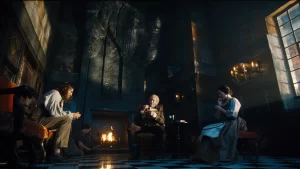
in Wuthering Heights.
This lack of trust between Fennell and the viewer is distracting from whatever substance of the movie there was. Furthermore, the hyper-fixation on the provocative aspects of Catherine and Heathcliff’s relationship makes the reader lose the grasp they have on the fact this is not a romance story. The book was never romantic, Heathcliff is not a love interest – he is devotion stripped of tenderness, love without mercy, grief that festers into revenge. It is important to keep in mind that the semblance of romance conveyed in the novel is a gothic romance, which takes place in a gothic novel. The novel tells the series of events that take place over generations, and warns the reader how passion, revenge, and the passage of time can culminate into a dangerous force that destroys lives long after that force is born. It isn’t a sweeping love story, but an obsession that consumes, and ruins everyone in its path. It is a portrayal of how some loves are hauntings, not happily ever afters.
To add on to the blunders of the adaptation, the film itself lacks convincing performances. One can’t help but wonder what the budget went to, if not coaches to help Elordi’s and Robbie’s terrible attempts at British accents. Robbie, who is known to be exceptional with accents in the past, was especially notable for how feeble and barely-there her accent was. In addition to that, she and Elordi lacked any kind of chemistry. Neither of them were able to convey the deep, controlling, all-consuming passion their characters had for one another. The ending scene, the famous monologue by Heathcliff after Catherine’s death, is delivered with monotone and painfully flat expressions devoid of grief. Both Elordi and Robbie gave perhaps the worst and most disappointing performances of their careers in this film. It is an insult to so badly miscast the characters, but it is only further salt in the wound to see two great actors give such weak portrayals.
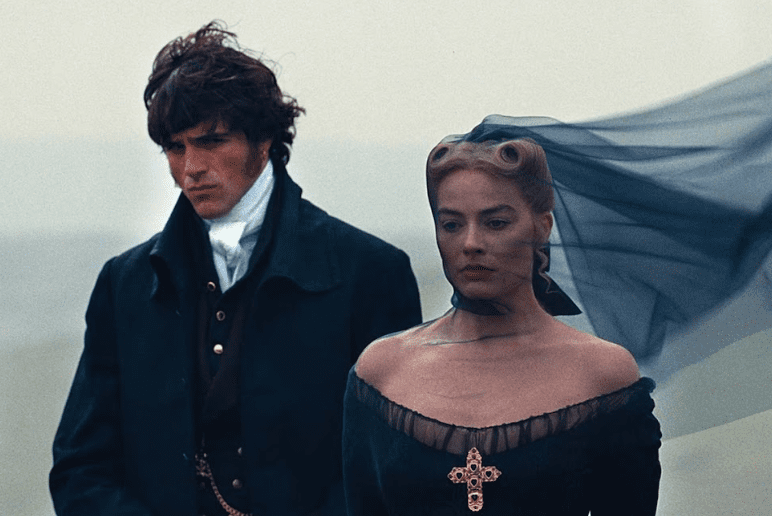
Jacob Elordi and Margot Robbie as Heathcliff and Catherine. As a whole, this film was a failure. It was a disgrace to Emily Brontë’s novel, and it is a shock so many people green-lit the release of this movie. Emerald Fennell herself said she does not think a novel such as Wuthering Heights could properly be adapted into film, for it is so complex and nuanced. If this is the case, and it most certainly is, she should not have attempted to do so. She could have made a different film and took inspiration from the toxicity, passion, and violence from the novel. She did not need to degrade a classic piece of literature in pursuit of making a “Saltburn”-esque film yet again. The lesson to be learned here is that some stories do not translate easily into some mediums of art. Some can only be told through word-of-mouth, sculptures, poetry, film, or novels. Wuthering Heights is a story that can only be truly explored and mutually understood by its author and reader in the written form. One can only hope, therefore, that Fennell’s adaptation will be forgotten to the passage of time, the same way Heathcliff’s vengeance and hate was forgotten to the silent moors of England.