

Written by Haley Garrett and Lyra Stoyas, Staff Writers
Deforestation goes global; spanning from the Congo to Canada, the unchecked destruction of the Earth’s forests signal that the Earth is rapidly pushing towards total ecosystem collapse.
Forests currently cover 4.14 billion hectares (a hectare is about 2.47 acres) of the Earth, accounting for about 31-33% of the plantet’s total land area (about ⅓ of the Earth). But a common misconception among the population is that deforestation is only in the Amazon Rainforest or that the loss of trees in a sector doesn’t affect anything outside of that area. In reality however, deforestation is a worldwide problem affecting the entire ecosystem and life cycles all across the globe. Climate change and biodiversity make this a global problem not a local problem.
The way that the population has organized itself as a people doesn’t account for how interconnected everything is, as one of the major drivers of deforestation is money itself. Industry focused on artificial production bring in millions of dollars that could be made more naturally and with less environmental impact if people could recognize the value of ecosystem services.
Politicians are paid off to allow these corporations to keep their company thriving with little care towards the people and communities these processes are affecting. People nowadays see everything through a lens of dollars, and the economic models of the world are broken because they don’t, and can’t, account for the value of the ecosystem. Financial incentives tied up in political corruption keeps effective changes to preserve the environment from being implemented on a timely scale.
There are policies put in place that keep people from being effective, like how hemp can produce about 10x the amount of paper the same square footage of trees would create, four times a year, yet that change won’t be implemented because of the corporations running deforestation institutions benefit from taking and converting land.
Another motive is the beef industry and the peoples’ demand for meat products. Not only does this industry remove forests for the cattle themselves, but also for large soy farms to provide food for the animals. This practice is mostly in the Amazon Rainforest and is responsible for roughly 12-14% of human caused greenhouse gas emissions, while a 2009 study shows that deforestation itself produces 6-17% of global greenhouse gas emissions.
As implied by the name, greenhouse gasses released cause a greenhouse effect that spans over the entire globe. They trap heat in the atmosphere, raising global temperatures and disrupting weather cycles. Greenhouse gasses cause the atmosphere to hold more moisture which energizes weather conditions and makes each weather anomaly more powerful. These come in forms such as, harsher droughts, harder storms, and heavier rainfall.
WWF Panda released an article stating that, “alone, the deforestation caused by cattle ranching is responsible for the release of 340 million tons of carbon to the atmosphere every year.” Yet, the true numbers today are reaching 3.3 gigatons of carbon in the atmosphere.
The way the planet cools itself is through its trees. Trees breathe in the CO2 and remove it from the atmosphere, directly cooling the Earth. This extra carbon produced from deforestation gets trapped in the atmosphere as Earth’s natural cycles aren’t able to control the levels. According to new research, by Callum Smith, Dominick A. Spracklen, et al. from the University of Leeds, deforestation is resulting in reduced rainfall across the tropics, which is disastrous for a biome that relies heavily on rainfall to thrive. The people living around these tropical forests complain of the temperature’s constant rise due to the loss of trees.
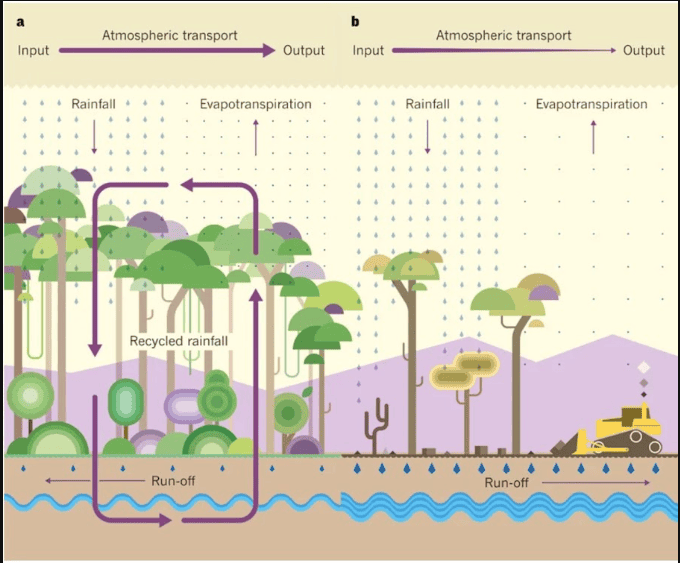
Satellite imagery from the last 14 years shows the correlation scientists have established between the loss of tree cover and the reduction of rainfall. If deforestation continues at its current rate, by the end of the century rainfall in the Congo will be reduced to 8-12% that will have impacts on biodiversity, farming, and the forests’ viability. Forests are one of the Earth’s major carbon sinks, which is why carbon is released into the atmosphere and in turn heating up the planet.
Another study, Smith et al. (2023) via Nature, shows that reduction of rainfall in the tropics is resulting in reduced rainfall worldwide caused by the disruption of evapotranspiration (when moisture from leaves returns to the atmosphere and forms rain clouds). The research team from the University of Leeds has released data that shows that for every 1% decrease in rainfall, average crop yields are reduced by 5%.
The decrease in rainfall ups the chances of forest fires, which are starting to become more of a problem than clear-cutting. Due to the lack of moisture in the atmosphere, forests have no way to recover from these wild fires, and the plants themselves are drier, making it so the fires have spanned a whole forest in mere seconds.
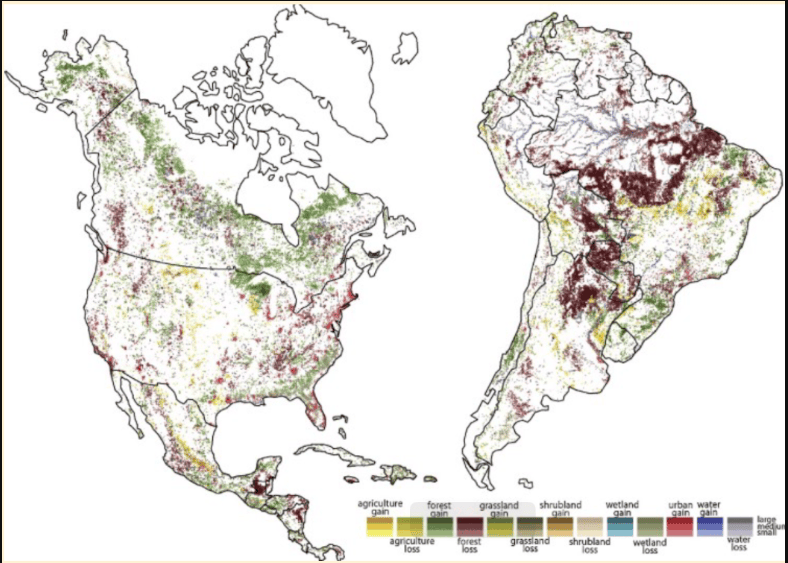
Satellite imagery from the European Space Agency illustrates how deforestation occurs comparatively slowly until about half the forest is gone, then the rest disappears very quickly. A study, by Tomasz Stepinski, shows that the biggest change from 1992 to 2015 was the conversion of forests into agricultural ranches.
To reiterate, part of why deforestation is so rampant is because of the profits produced from the act. Corporations get revenue from the timber industry and the farms planted where the forest used to be. The larger powers continually push away better alternatives to better the vitality of their businesses and the profits reaped from the calamity produced.
When people become accustomed to something, they don’t make the effort to observe what lies outside of what they are comfortable with and aware of. They also don’t want to give up what they’ve gotten used to consuming, mostly because people won’t listen if information presented contradicts their beliefs.
Some believe that nobody learns anything except through direct experience, saying how the population needs to learn about what they’re doing and be conscious about it to even make a slight impact. The little actions like throwing something out in the right bin, or being conscientious about how much meat or other products they’re consuming and buying.
These incentives are an example of the Tragedy of the Commons, where people simply won’t listen until they have to change their way of life. The Tragedy of the Commons also relates to the continual over-usage of resources until they are exhausted. Individual people need to think about the consequences of their own actions and think about how people can change little things about how they live to make further progress as a population.
Deforestation is no longer just an environmental threat isolated to tropical regions; it is an active driver of global climate destabilization. By disrupting Earth’s critical water cycles and carbon sinks, systemic forest destruction has created a self-reinforcing crisis of droughts, wildfires, and agricultural collapse. Yet, trapped within the framework of the Tragedy of the Commons, global society continues to prioritize short-term corporate profit over long-term ecological survival. Relying solely on a reactive human survival instinct is a dangerous gamble. If we wait until the devastation directly threatens every individual life before demanding institutional change, we will have already crossed the threshold into permanent ecosystem collapse.