

By Haley Garrett, Staff Writer
Humans’ attention spans and mental health are currently decreasing across the world due to short-form videos.
Short-form video apps, including Instagram, Tiktok, and Youtube, are affecting how students of all ages think. The videos are lowering attention spans as well as mental and physical health.
Watching content on Instagram Reels and Youtube Shorts has been proven by the National Institutes of Health (NIH) to give rapid hits of dopamine to consumers. This dopamine, also known as the “happy” or “feel-good” hormone, makes people want to continue watching, leading to a short-form video addiction.
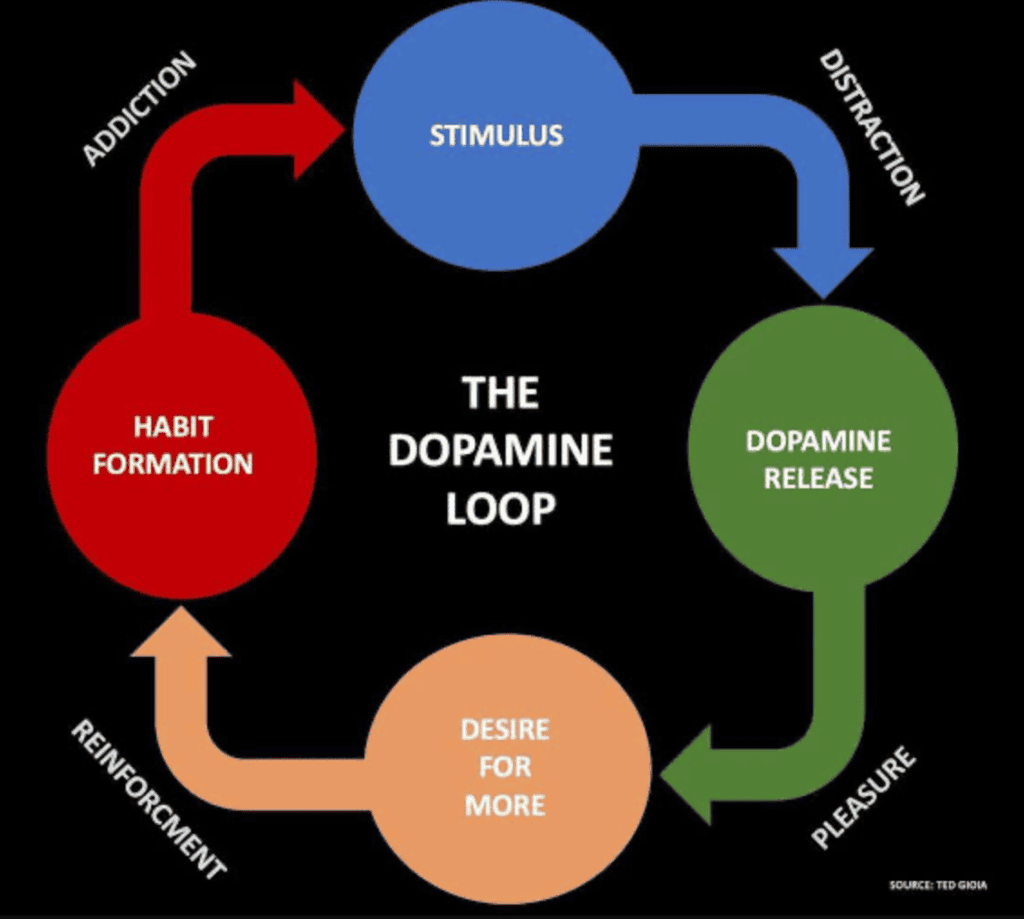
There are two classified types of internet addiction. One is broad internet addiction, the other is specific internet addiction. Specific internet addiction follows the premise of being addicted to a specific part of the internet, like social media, gaming, or quick videos.
Data published by Nature shares how this addiction can lead to academic procrastination: “short-form video addiction (SFVA) is defined as an individual’s inability to self-regulate their use of short-form video applications, despite significant distress and functional impairment, which is thus considered a specific subtype of internet addiction.”
As individuals become addicted to this quick and easy enjoyment, time, as well as the will to stop and do other work, is lost. This leads to procrastination, not only for academic topics but for simple daily tasks needed in everyday life. This happens as students look for quick satisfaction, instead of long-term rewards, similar to gambling.
In an article from the NIH, it shares how procrastination also leads to problems with mental health and diminishes expectations for one’s self. “Students might perceive that they cannot attain quick academic rewards, leading to a loss of confidence in their studies and they cannot complete their academic tasks on time.”
Short-form video apps can also lead to the brain being overstimulated, as there is active comparison between an individual and videos watched, overall decreasing self esteem.

This addiction to short-form videos also leads to cognitive impairment. Attentional control is a cognitive function that allows individuals to hold attention. Effective attentional control demands active engagement of cognitive resources in order to understand relevant information and suppress irrelevant information.
The NIH explains that when humans see distractions, such as TV shows, due to the fact that the shows are meant to be engaging, it impairs the ability to be able to concentrate and focus on a task. “Highly arousing content typically elicits strong excitement in the brain, leading to an increased allocation of cognitive resources for information processing and a more frequent shift in attentional focus.”
Brief videos are even more effective, as they are made to be an easy and quick way to receive arousal in the brain. This connection is what leads teenagers’ attention spans in a downward spiral, making it so that many students feel that they aren’t able to focus for more than a few minutes, and even watching a ten minute video feels too long.
Boredom proneness is a personality trait that makes an individual feel bored, unhappy, restless, and meaningless, and it has been shown to affect short-form video addiction. A person who has higher levels of boredom proneness is more likely to be addicted to short clips or movies.
While there is a negative side, there is a positive one too. Boredom proneness can also be a reason why individuals don’t watch video clips and use social media, and instead put their phone down and go to study.
“The problem isn’t using them, it’s using them without awareness,” the NIH states. Social media is replacing many things like reading, long conversations, deep work, and creativity.
While the brain needs quick hits of happiness, it also needs to be worked in order to function properly. Short-form videos affect the ability of the brain’s functions and leads to a decrease of attention spans. Attention spans are needed as they lead to higher levels of academic learning, and better mental health as grades and mood increase from lack of procrastination and comparison.