

Written by Kathryn Burke, Staff Writer
Poly sophomores delivered their excellent, well thought-out projects for the Science Fair, displaying their interests and efforts.
All honors chemistry students participated in the Science Fair, but few were able to advance to the district competition. All of the projects displayed the individual or group’s interests in human studies, physiological reports, chemistry experiments and environmental observations. When speaking to Mr. Schiller, the honors and AP chemistry teacher, he shared his knowledge acquired from the past twenty years of leading the Science Fair at Poly. He thinks that it is best for students to pick topics they find interesting to better enjoy and understand the process despite it being a requirement. Mr. Schiller shared that the best moments are seeing students succeed as he holds a sense of pride due to their efforts.
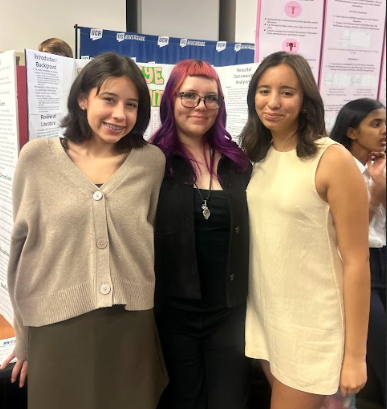
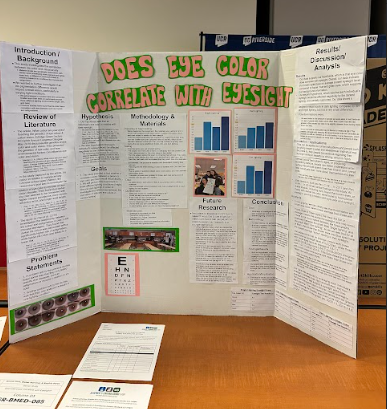
Sophia Perez (10), Emma Caro (10), and Sialea Martinez’s (10) project was on the correlation of eye color to eye sight. They used an eye chart to test peoples eyesight, asked questions relating to the test, and used the results to determine if eye color had any effect on sight. They had thirty two participants and determined that those with brown eyes tend to experience worse vision. They shared that the biggest challenge with the experiment was getting enough participants and having only one classroom to experiment in which limited time and reliability. Despite the challenges, they explained that seeing the UCR campus was fun and seeing other projects was interesting. They advise those planning to participate in the science fair to not be too harsh on oneself, do something that sparks passion, and to have a good idea on how many participants will be needed.
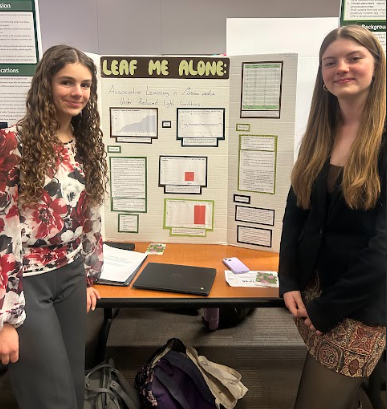
Adrineh Spring-Pearson (10) and Gabriela Votruba’s (10) project, “Leaf Me Alone”, compared the behaviors of touch-sensitive plants in different environments. They compared amounts of light provided during the growth process and observed how it affected the growth and flowering. They concluded that plants in low-light environments did not associate light with touch, meaning light conditions effecting sensory issues. They both agreed that the biggest challenge in this experiment was getting accurate data due to the plants being touch-sensitive, and plants dying along the way. Votruba shared that having a partner made it fun, and that having someone to rely on released some of the pressure of the project. Spring-Pearson advises those wanting to prepare for science fair to be very careful in picking partners, making sure they are responsible, and to start on projects soon; she shares that being prepared to work hard and display a good presentation for the Science Fair is very important.
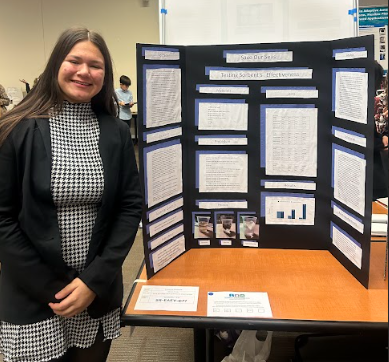
This year, eight projects were sent to the district level with three projects advancing to county: Gabriel Anderson (10) and Chloe Ravanta (10) with the aerodynamics of winglets, Emily Baulos (10), Rowen Fullivon (10), and Charlotte Zunishe (10) with optimizing AI prompts, and Caydence Chitwood (10) with testing sorbent’s effectiveness. Congratulations to all that went to district, and good luck to the three groups advancing!